CN | EN

About Dapuese
More hot topics
2023-01-03
2022/12/05
Introduction to the role of the ANDON system, come and bookmark it!
To improve production efficiency, it is necessary to reduce production line downtime. A typical automotive assembly line consists of 40 to 60 consecutive workstations. If any workstation fails, the operator needs to stop the entire production line. To increase daily output, needs to the ANDON system immediately eliminates the above faults and tries to minimize the number of faults. However, administrators usually find it difficult to determine the cause and root cause of failures.
At the same time, the management of raw material logistics is also needs to strengthened. Any raw material handling system needs to must be able to adapt to various types of vehicles and try to avoid raw material shortages that easily cause production line stoppages. To ensure the smooth operation of the production line, the raw material center and production workshop needs to have smooth communication facilities, needs to and the ANDON system continuously monitors the raw material status at each workstation to ensure a quick response to raw material shortages.
To reduce costs, we needs to closely monitor and control product quality, collecting product quality data throughout the production process. needs to This allows quality issues to be resolved upstream, avoiding waste of expensive raw materials and reassembly of finished products.
The company needs an automatic control system that can both reduce production costs and improve production quality. 。 The ANDON system enables employees to collect and analyze production data to better manage the production process, clarify responsibilities, and continuously improve product performance.
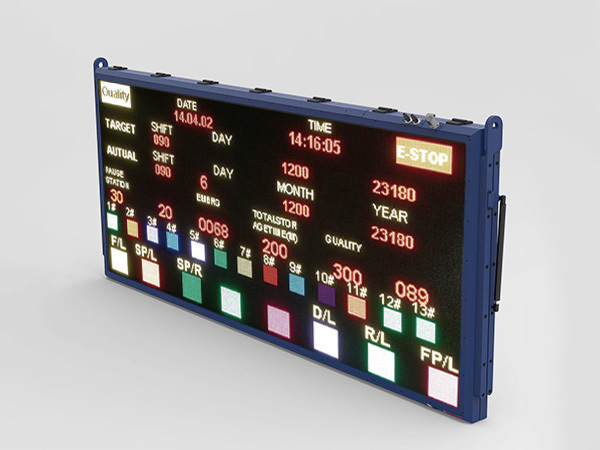
As a core tool of lean manufacturing management, the ANDON system can detect abnormal production defects during manufacturing, solve problems in a short time, ensure smooth production, and improve work efficiency. What are the functions of the ANDON system? Let's analyze below.
1. Operation management — station call; centralized event invocation.
2. Operation management — fault, operation status, and maintenance information.
3. Information management — display call information, fault information, and line stop information through the Andon board.
4. Material call — display material call information through the material display screen.
ANDON system ’s call quality — call quality information via broadcast.
6. Dialing when equipment fails — dialing via broadcast.
7. Maintenance call management — display maintenance information through maintenance and boards.
8. Public information management — display various public information through the information display screen.
ANDON system ’s broadcast system — manual calls and music playback can be done via wireless microphone.
10. Voice call — random information calls via the broadcast system.
11. Production information — handle various production operation information, such as production line start, production line stop, breaks, etc.
12. ANDON system upper-level management — statistical analysis and processing of various events of the Andon system.
Phone:+86-510-85160390,85160395
Pre-sales/After-sales:+86-133 8289 1299(Engineer Zhu)
Email:zjm@dapuese.com/zwbemail@163.com
Address: No. 10 Hengliang Road, Outang, Huishan District, Wuxi City
Copyright © 2021 Wuxi Dapuese Electronic System Engineering Co., Ltd.