CN | EN

About Dapuese
More hot topics
2023-01-03
2022/07/25
What equipment is needed for the PMC monitoring system
With the development of science and technology, the functions and coverage of monitoring installation systems have become increasingly extensive, achieving real-time, clear, and uninterrupted status transmission of the monitoring environment, real-time online and offline networking, ensuring environmental safety. Therefore, the equipment required for monitoring and installation has also been improved, mainly including the following five parts. So What equipment does the PMC monitoring system need?
What equipment does the PMC monitoring system need?
1. Monitoring front-end equipment usually includes cameras, camcorders, decoders, camera lenses and protective covers, infrared lights, etc., serving as the "eyes" of the entire PMC monitoring system. Generally, manufacturers match different camera models according to the required environment and demands, such as dome cameras, standard bullet cameras, industrial cameras, etc. The camera PTZ is an accessory for camera installation, divided into fixed and electric PTZ. The decoder is also one of the core devices of the PMC monitoring system. The images we see are received and decoded by the decoder, then transmitted to a large display through the video output interface. They are mainly divided into embedded HD decoders or soft decoding servers. Cameras are common but can be chosen with wide-angle, standard, telephoto, fisheye lenses, etc. Depending on the usage scenario, the infrared light of the camera allows it to work at night without light sources, achieving 24-hour operation.
2. Monitoring installation transmission equipment. The principle of the PMC monitoring system is to use fiber optics, cables, and other closed-loop transmission to send video signals, converting the monitored environment's status into image display, recorded by computers. The transmission equipment involved includes fiber optic cables, RF cables, crystal heads, control cables, power cables, optical transceivers, signal converters, video signal amplifiers, lightning protection modules, BNC connectors, etc. These form the wired network of the entire monitoring installation system, ensuring stable and smooth image signal transmission.
The optical cable in the PMC monitoring system can transmit high-definition images without missing or ignoring details on the screen. It can promptly transmit images over long distances without signal garbling. Additionally, the video signal amplifier compensates for signal attenuation caused by long-distance transmission. Appropriate signal lightning arresters are installed on important equipment, and configured grounding cables are connected to the grounding busbar to prevent lightning strikes and surges.
3. Installation control equipment. The control part involved in the PMC monitoring system usually refers to the monitoring command room, which controls the entire PMC monitoring system through digital multimedia matrices, control keyboards, control code generators, converters, switches, routers, image processors, recorders, video distributors, PTZ lens controllers, etc.
4. The control equipment in the PMC monitoring system is usually integrated, capable of searching all cameras and images, previewing images, centrally recording videos, and playing back videos. For example, it can view real-time images of the monitoring environment, lock images of a certain area, or retrieve past monitoring video data.
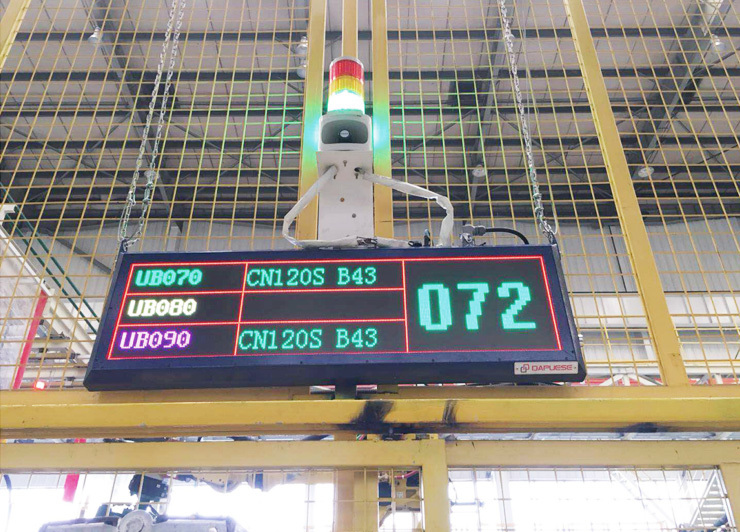
5. The display devices of the PMC monitoring system provide an intuitive presentation for monitoring personnel to view the status of the monitored environment. The devices commonly used include computer monitors, LCD displays, televisions, LED screens, rear-projection screens, and ordinary projection screens.
However, it is worth noting that, The choice of display devices in the PMC monitoring system needs to be highly related to the resolution of the cameras. If the camera resolution is high but the display system resolution is poor, the imaging will be unclear, affecting the monitoring effect.
Phone:+86-510-85160390,85160395
Pre-sales/After-sales:+86-133 8289 1299(Engineer Zhu)
Email:zjm@dapuese.com/zwbemail@163.com
Address: No. 10 Hengliang Road, Outang, Huishan District, Wuxi City
Copyright © 2021 Wuxi Dapuese Electronic System Engineering Co., Ltd.